The Bag, the Dolphins, and the House of Missing Selves
There are dreams that arrive like weather. They pass over the town of the mind, leave a dampness on the stones, and move on.
And there are others that do not pass.
They sit.
They take a chair in the dim back room of the house and wait—patient as winter fruit—until the season is right for tasting.
This one sat.
In it, I was called back to class one last time. The corridors carried the same chalk-dry air I had always resisted. Somewhere between the classroom and the stairwell, I became a student again.
An old professor appeared—stepping out of years as if they were only a curtain—and told me he was proud of me. Proud of the criminal psychologist I had become. He carried a message I could not remember. Perhaps the message was simply his presence.
Then the dream shifted.
We were at the edge of town, with a friend. Fields, abandoned houses, girls gone missing. A friendly girl waved from a passing team and invited us inside.
The room was half-basement, half-buried. The kind of place where daylight forgets itself.
She served cereal—the ritual of school mornings, though never quite mine. Then something in her movement broke. It became sharp, mechanical. From behind, she changed.
Pale blue. Not the color of water, but of something that had lived too long under artificial light.
A Delphinanthropos.
The cereal spilled from her mouth like something rejected. My friend died. A father appeared—also blue. A pool formed, sudden as an eye opening. They dove. They emerged. They chased me.
At the doorway stood a small brother, already changed.
No one knew whether these creatures had taken the missing girls—or whether the missing had all become creatures.
The dream did not leave.
It stayed for days. Then weeks.
Like a letter I was not ready to read.
And then, without warning, something weird happened.
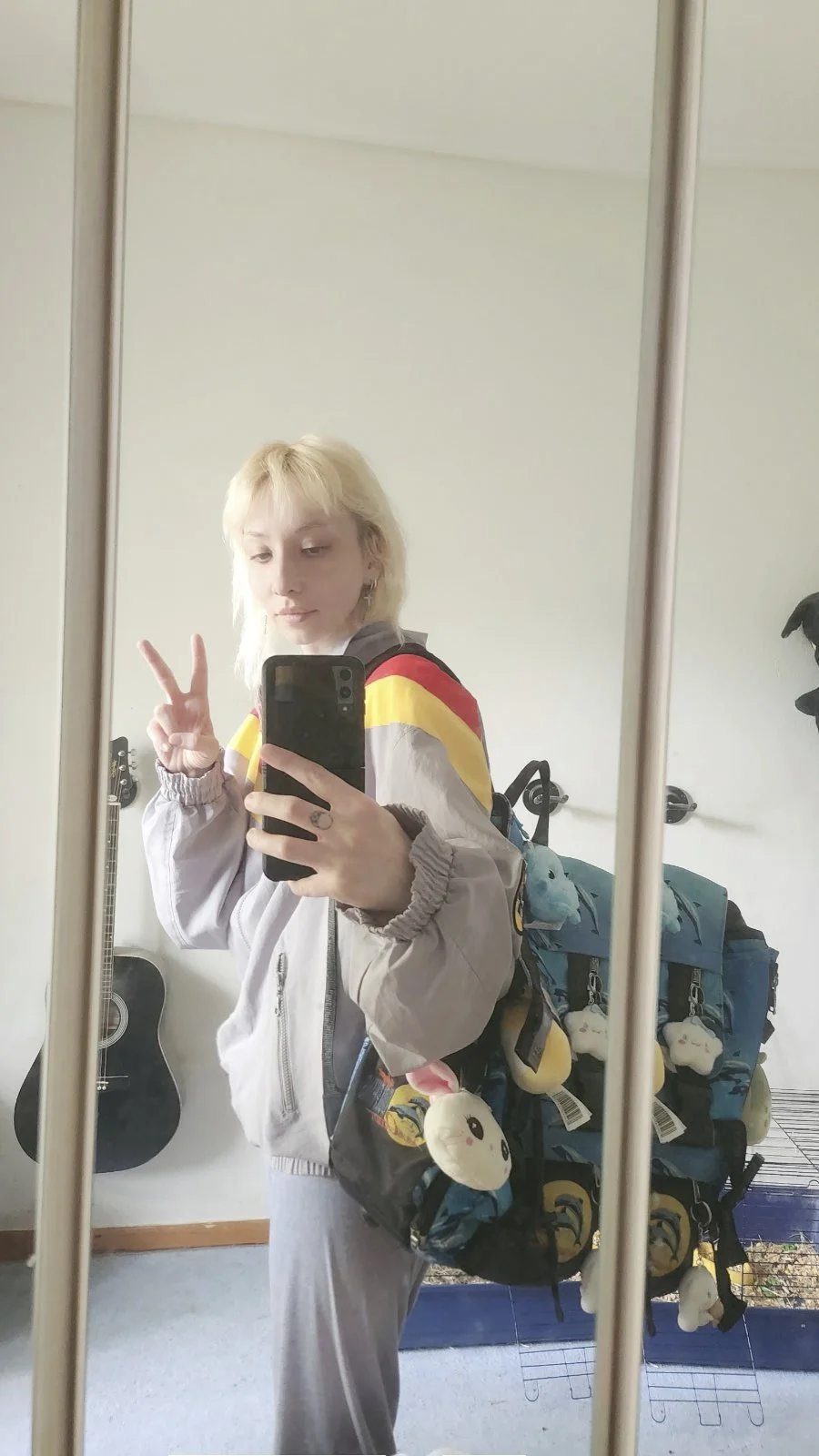
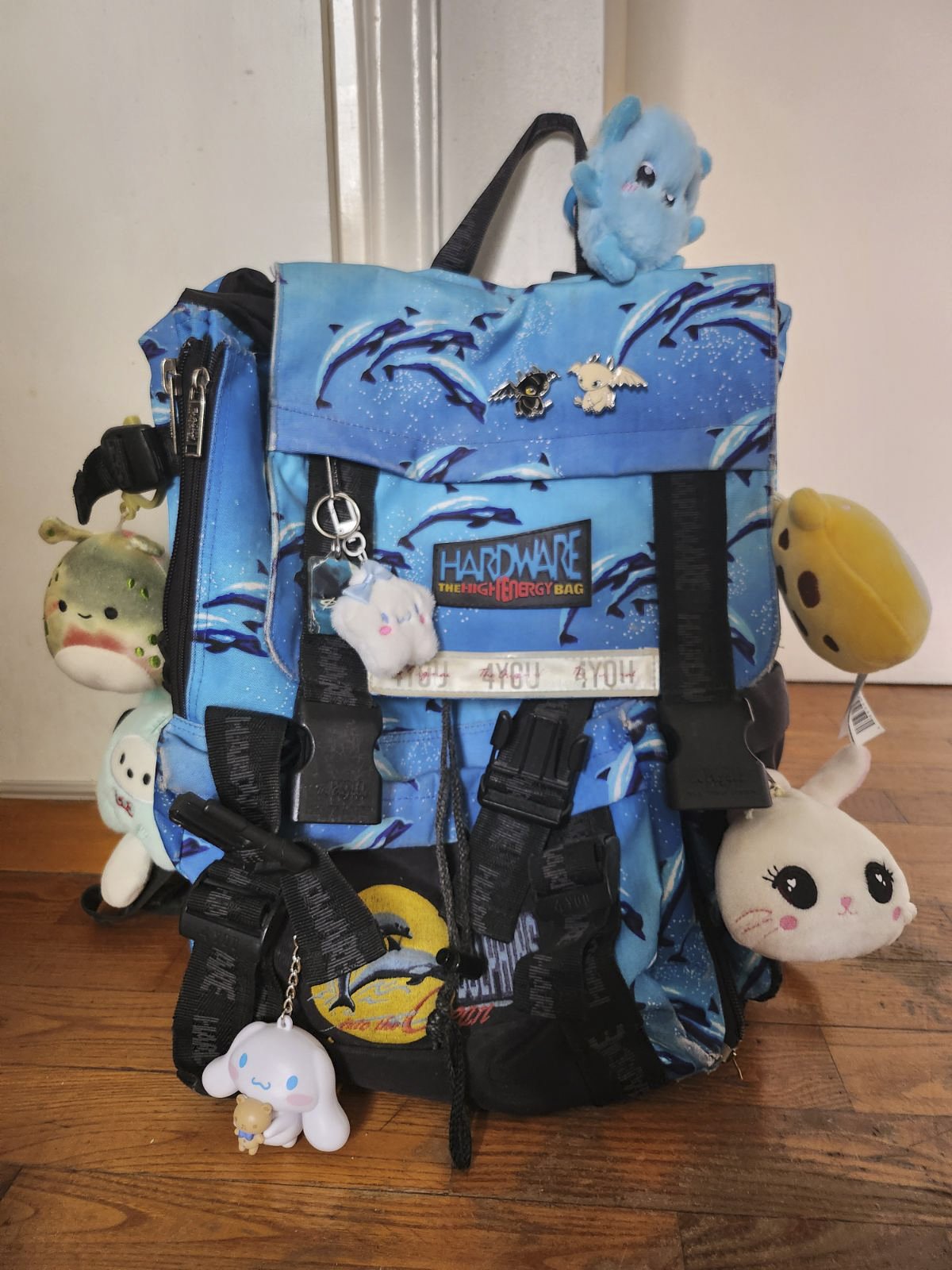
I found my old schoolbag.
The same one I had carried from childhood to eighteen—a quiet, stubborn continuity. For years, it carried a kind of weight I didn’t question. Every time I came across it, there was a faint tension in my body, as if it belonged to a version of me I had never fully left.
So I began to change it.
I added plush figures. Soft objects. Small, almost absurd things that had no place in the world it came from. My hands moved before I understood why.
I wasn’t repairing it.
I was breaking something.
And then, only after I had changed it, I saw it.
Not just saw—but noticed.
The bag was blue.
And covered in dolphins.
I had always known that. I had seen it countless times. But I had never really registered it.
Not until something in its meaning had loosened.
Not until it stopped holding the same quiet authority over me.
And in that moment, the connection appeared.
The blue.
The dolphins.
The Delphinanthropos.
The dream had been there all along.
I just hadn’t been able to see it.
The creature was not one.
It had three faces.
The child at the doorway.
The teenager at the table.
The father by the pool.
One self, divided across time.
The child—the first solitude. The secret awareness. The inward current that stood at thresholds and watched.
The teenager—the mask. The version of me that learned to sit, to smile, to perform normalcy. The one who could invite others in, even when the space itself was wrong.
The adult—the authority. Not chosen, but absorbed. Returning with weight, with force, when I tried to inhabit roles that were never mine.
Not enemies.
Not monsters.
Fragments.
And the missing girls.
They were not only part of that dream.
They were parts of me.
Playfulness. Trust. The right to choose my own way of being. The freedom to create without permission. The small, wild satisfaction of doing what felt true—writing instead of teaching, making instead of performing.
In that half-basement room, something ordinary had been turned into something wrong.
Nourishment into compulsion.
The body had refused it.
The dream had shown me how.
After that I wrote the dream down to keep it from disappearing. I walked through it again, slowly, through each part without forcing meaning.
The professor.
The abandoned houses.
The pool.
And the blue creature.
I spoke to it.
What did you protect?
What did I lose while trying to become acceptable?
The answers did not come all at once.
Sometimes they came as permissions.
I kept changing the bag.
I changed small rituals.
I stopped forcing what never nourished me.
The dream did not vanish.
It changed.
The chase softened. The water deepened without pulling. The creatures did not disappear—but they no longer needed to.
Sometimes we stood together, looking at the same landscape.
I am telling this for a simple reason.
We are taught to capture dreams quickly—to pin them down before they fade. And yes, that has its place.
But some dreams are not meant to be understood immediately.
They wait. They sit in the background of your life until something in your hands becomes honest.
And then they return.
Dreams are not something to fear, even the scary ones—but they something that shows you where the missing parts have gone.
And how, slowly, you might begin to bring them back.